

• Free Delivery Over £99*
  • No Minimum Order
  • Price Match Guarantee
  • TrustPilot 4.8

Top 5 Mistakes To Avoid When Ordering Branded Workwear

Branded workwear does so much more than keep your team looking uniform. Done well, it builds customer confidence, boosts your brand, and gives staff a sense of belonging. Done badly, it wastes budget, frustrates employees, and lets the business down.

Branding experts since 1976

Most branded workwear mistakes are avoidable, and they tend to follow the same pattern.

Whether you’re placing your first order or reviewing a uniform that isn’t working, here are five usual pitfalls and how to get around them.

Mistake 1: Choosing Price Over Quality

It’s always tempting to go with the cheapest option, particularly when ordering large quantities. But low-cost garments can bring hidden costs that only come to light a few months later.

Thin, poorly constructed workwear fades quickly, loses shape after washing, and can pill or fray at the seams - taking your brand’s appearance with it. A polo that looks smart on day one but is tired by week six isn’t a saving; it’s an early reorder.

There’s also a perception issue. Your workwear is often the first thing a customer sees. Garments that look worn or cheap send a message about your business that no amount of marketing spend can easily undo.

Fabric weight is a reliable quality indicator. A heavier GSM (grams per square metre) generally signals a more durable garment. If safety requirements apply, check that garments carry the right certifications, and read supplier reviews with an eye on longevity.

Spending a little more upfront on quality garments can save budget over a two- or three-year uniform cycle than replacing cheaper ones twice as often.

Mistake 3: Poor Logo Placement and Sizing

Your logo is arguably the whole point of branded workwear. Getting it wrong - through poor positioning, incorrect sizing, or misaligned artwork - undermines the investment.

The most common errors are logos too small to read at a distance, oversized designs that look like a misprint, and placement that ends up obscured by jacket zips, collar folds, or bag straps.

Standard placements exist for a reason. The left chest is the default for most garments as it sits in the natural eyeline. Back prints work well for outerwear, such as site or logistics work. Sleeve logos add a secondary brand moment without competing with the main placement.

Before you commit to a full order, ask your supplier for a visual mock-up showing logo placement to scale on an actual garment. If they can’t provide one, that tells you something. Check how the placement interacts with any pockets, seams, or fastenings on the finished item.

Size is also key. A logo that looks proportionate on a size medium may swamp an XS or disappear on a 3XL. If you’re ordering across a wide range, confirm whether the logo scales with the garment or stays fixed, and what that looks like across the full range.

Mistake 4: Ignoring Branding Methods - and not Using an Expert

Embroidery and printing are not interchangeable. Each method suits different garments, different uses, and different brand aesthetics. Using the wrong one produces results that won’t last, won’t look right, or won’t represent your brand well.

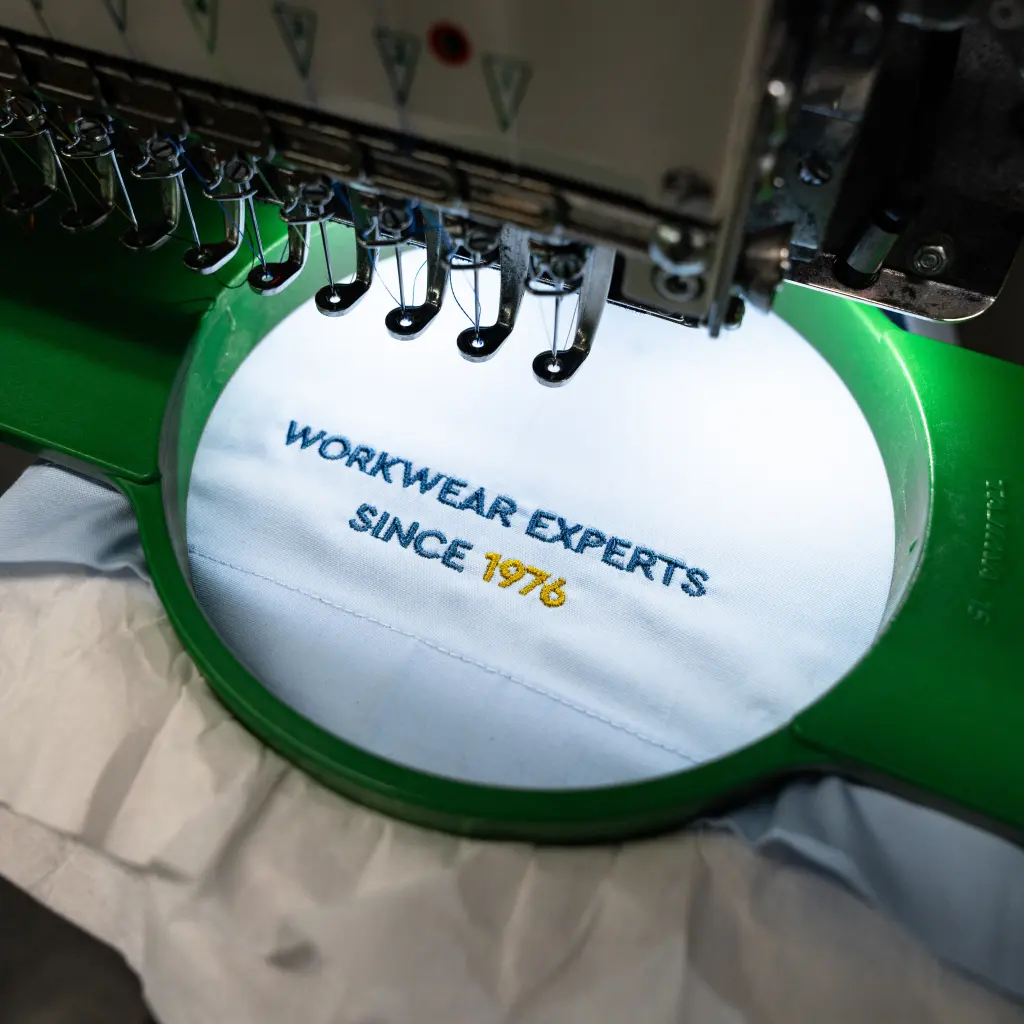
Embroidery is the standard for corporate and professional workwear: polos, fleeces, jackets, and caps. It’s durable, looks premium, and holds up well through repeated washing. It’s the right choice for workwear intended to be worn and washed regularly over a long period. The limitation is detail. Very fine lines, small wording, or complicated gradients don’t translate well to thread, so logo files sometimes need simplifying for embroidery.

Print handles detail and colour complexity better. It suits promotional or event-led apparel, or garments where a large back print is the base of the design. The trade-off is durability. Print on heavy-use workwear that goes through industrial washing cycles may potentially fade, crack, or peel faster than embroidery.

The mistake many businesses make is basing decisions on cost or preference over fit for purpose. A printed logo on a site worker’s jacket that peels by month three is not cheaper than embroidery; it just costs the same amount twice.

A good workwear supplier will advise on the right method for each garment type, flag when a logo needs adapting, and highlight issues ahead of expensive changes.

Mistake 5: Not Ordering Samples or Checking Sizing

Sizing is not consistent across workwear brands. A large in one manufacturer’s polo sits differently from another’s. When you’re ordering for a team of thirty, those differences could mean unhappy staff and a returns process nobody wants to manage.

Ordering a sample or a size set before committing to volume is one of the simplest and smartest ways to avoid this, yet it’s regularly skipped in the interest of speed. A week spent checking samples is considerably less painful than unpacking three hundred ill-fitting garments.

Where a full sample order isn’t possible, ask your supplier for a size guide that is specific to the brand and garment you’re ordering. Better still, ask whether they hold stock samples you can circulate to staff for fit checks before the order is placed. This is particularly important for inclusive workwear, since men’s and women’s bodies fit workwear differently.

A few other things worth checking before you sign off on a bulk order:

  • Do the garments wash well at the temperature your team will use? Check care guidance against likely washing conditions, particularly for hospitality or healthcare roles where high-temperature washing is standard.

  • Does the colour match your brand correctly? Screen representations of colours can shift. Ask for a physical swatch of a print proof to check colour consistency.

  • How does the branding look on the finished sample, not just the mock-up? Logo placement, thread colour, and print finish can all look different on a physical garment than on screen.

MyWorkwear team

The Cost of Getting it Wrong

Branded workwear mistakes rarely show up as a single, obvious bill. They accumulate until the decision looks a lot more expensive in hindsight than it did at the time, whether it’s reorders, staff complaints, faded logos, or early replacements.

The businesses that get workwear right ask the important questions of their supplier, staff, and the brief early. They treat it as a brand decision rather than a procurement checkbox.

If you’re looking for a personalised workwear guide for your business, whether you’re starting from scratch or reviewing a uniform that isn’t working, our team can help. Chat to us about garment selection, branding, sizing, sample orders, and more.

Here at MyWorkwear, we have been proud suppliers of personalised workwear since 1976.

To see how we can provide the perfect workwear for your team to keep them looking professional and performing at their best, please click the button below.