

Hard hats and safety helmets are essential pieces of personal protective equipment (PPE) on many UK work sites. So, what do the different colours mean?
The colours can make it easier to identify different roles, responsibilities and groups of people on site.
Understanding hard hat colour codes can help construction workers, site managers, contractors and visitors recognise who is responsible for particular tasks and who to approach for assistance.
In the UK, Build UK’s Safety Helmet Colours Standard provides a recognised system for identifying site roles through helmet colours. However, colour coding is not a universal legal requirement and individual sites may have different arrangements.
In this guide, we'll explain what different hard hat colours can mean, how colour coding works on work sites and what to consider when choosing safety helmets for your team.
What Do Hard Hat Colours Mean?
Hard hat colour codes help make busy workplaces easier to navigate. Although meanings can vary between employers and projects, the following outlines the colours used in Build UK's recognised standard and some alternative associations you may encounter.
White - Site managers, component operatives and vehicle marshals
Yellow - General site operatives
Blue - Technical workers, electricians or other specialist trades
Green - First raiders or workers with specific site responsibilities
Red - Fire marshals
Orange - Slingers and signallers
Black - Site supervisors
These colours aren't universal UK requirements. The meanings of yellow, green and red in particular may differ from one site's arrangements to another. Always check the site's colour-coding policy rather than assuming a helmet colour tells you someone's role.
White Hard Hats
White safety helmets are typically worn by site managers, competent operatives and vehicle marshals.
Site managers coordinate day-to-day site activities, oversee progress and help ensure that work is carried out safely. Competent operatives have the relevant skills, knowledge and experience for their work. Vehicle marshals help manage vehicle movements and reduce the risks associated with reversing and moving plants.
Where vehicle marshals wear white helmets, they are distinguished by a different-coloured high-visibility vest.
Black Hard Hats
Black safety helmets are often used to identify site supervisors.
Supervisors oversee workers and activities within their area of responsibility. They may coordinate tasks, monitor working practices, communicate instructions and raise safety concerns.
Recognising a supervisor quickly can make it easier for workers and visitors to find the appropriate person when they have a question or need assistance.
Orange Hard Hats
Orange safety helmets often help identify roles such as slingers and signallers.
These workers have important roles in lifting operations. A slinger attaches loads to lifting equipment, while a signaller communicates instructions to the crane operator or other machinery operators, often using agreed hand signals or communication equipment.
Clear identification helps other workers recognise the people coordinating lifting activities and understand who is involved in directing the movement of loads.
Blue Hard Hats
Blue helmets are typically used by people on site who are not undertaking one of the other specified roles.
This can include a range of workers and personnel, depending on the project's arrangements and the roles assigned to other colours.
Some older or alternative colour-coding systems associate blue helmets with electricians, technical workers, apprentices or visitors. These associations should not be treated as universal UK rules.
Are Hard Hat Colours Legally Required?
Hard hat colours are not generally specified by UK law for individual work roles. The distinction is between the legal requirement to manage head-injury risks and the industry practice of using colours to identify people.
The Health and Safety Executive (HSE) explains that suitable head protection must be provided and worn where a risk of head injury remains after appropriate control measures have been implemented. On most work sites, this means head protection is necessary.
However, the law does not generally require every site manager to wear white, every supervisor to wear black or every slinger/signaller to wear orange.
Employers and contractors can establish site-specific colour schemes, provided they meet their health and safety obligations and communicate the arrangements effectively. A client or principal contractor may also make compliance with a particular scheme a condition of working on a project.
For employers, the practical approach is to document the chosen system, explain it during site inductions and make sure everyone understands the colours and their meanings.
Does Hard Hat Colour Affect Protection?
Put simply, no. The colour of a hard hat does not, by itself, determine how much protection it provides.
Two helmets in different colours may have the same protective specification, while two helmets of the same colour may have different designs and capabilities.
When selecting safety helmets, consider the following factors:
Relevant safety standards: Check that the helmet meets the standard appropriate for its intended use, which can be found in the product descriptions.
Working environment: Consider risks such as falling objects, impacts, electrical hazards and working at height.
Helmet design: Choose a helmet suitable for the hazards identified by your risk assessment.
Fit and adjustment: The helmet should fit securely and be worn according to the manufacturer's instructions.
Compatibility with other PPE: Check that the helmet works safely with required ear defenders, eye protection, face shields and other accessories.
Condition and maintenance: Inspect the helmet regularly and follow the manufacturer's instructions for cleaning, storage and replacement.
Which safety standards should you look for?
The appropriate safety standard depends on the type of work and the hazards involved.
These standards cover different types of head protection and applications:
BS EN 397: Industrial safety helmets, commonly used in construction and industrial workplaces.
BS EN 12492: Mountaineering helmets, which may be relevant to certain specialist work-at-height applications where the helmet is suitable for the task.
BS EN 14052: High-performance industrial helmets designed to provide enhanced protection against certain impacts.
The appropriate standard depends on the work being undertaken and the hazards involved. Do not assume that a helmet designed for one application will provide all the protection needed for another.
For suitable options, explore our range of hard hats and safety helmets.
How to Choose the Right Hard Hat for Your Team
Choosing the right helmet involves more than selecting a colour. Employers, site managers and purchasing teams should consider the following points.
1. Assess the working environment
Start by identifying the hazards workers may encounter. These could include falling objects, collisions with fixed structures, electrical risks or other workplace-specific dangers.
Use the findings of your risk assessment to determine the type of head protection required.
2. Check the relevant standards
Confirm that the helmet is suitable for its intended application and meets the relevant safety requirements. Buy from a reputable supplier and check the manufacturer's product information.
3. Consider compatibility with other PPE
Workers may need hearing protection, eye protection, face shields or other equipment alongside their helmets. Make sure the selected products are compatible and approved for use together.
Explore MyWorkwear's head protection accessories for options such as compatible chin straps, helmet liners and visor-related accessories.
4. Select the correct colour
Once the appropriate helmet has been identified, choose a colour that matches your site's colour-coding policy.
For employers purchasing helmets for a workforce, it is worth confirming the colour requirements with the principal contractor or site manager before placing a bulk order.
5. Check fit, comfort and adjustment
A helmet must fit correctly to provide the intended protection. Check the adjustment system, retention requirements and manufacturer's instructions, and ensure workers know how to wear and adjust their helmets properly.
Comfort also matters, particularly when helmets are worn throughout a shift. Depending on the environment, features such as ventilation and compatible winter liners may be worth considering.
6. Establish an inspection and replacement process
Workers should check their helmets before use and report any damage or concerns. Employers should ensure that inspection, maintenance and replacement arrangements follow the manufacturer's guidance and site requirements.
A colour-coded helmet is only useful if it remains suitable for the job and in good condition.
Why Do Construction Sites Use Hard Hat Colour Coding?
Hard hat colour coding helps people identify roles quickly in busy working environments. Its main benefits include:
Quicker identification: Workers can more easily recognise supervisors and personnel with specific responsibilities.
Clearer communication: People can identify whom to approach with questions or concerns.
Better site organisation: Consistent colours help establish a shared understanding of responsibilities.
Support during emergencies: Identifying designated personnel can help people locate the appropriate contact, although emergency arrangements must be clearly communicated.
Easier inductions: A clear colour scheme can help new starters and visitors understand the site's structure.
Colour coding supports site organisation, but it is not a substitute for training, clear signage, supervision or formal safety procedures.
Hard Hat Colour Coding for Visitors and New Starters
Visitors, temporary workers, subcontractors and new employees may be unfamiliar with a site's colour scheme.
An induction should explain which helmet colours are used, what they represent and who is responsible for particular activities. It should also explain any additional identifiers, such as role-specific stickers or high-visibility clothing.
Do not assume that a visitor knows what a colour means simply because they have worked on another construction project. Different sites may use different arrangements, and even a widely recognised colour convention can be applied differently by individual organisations.
Where visitors are required to wear a particular colour, provide suitable head protection and explain how it should be fitted and worn before they enter the relevant work area.
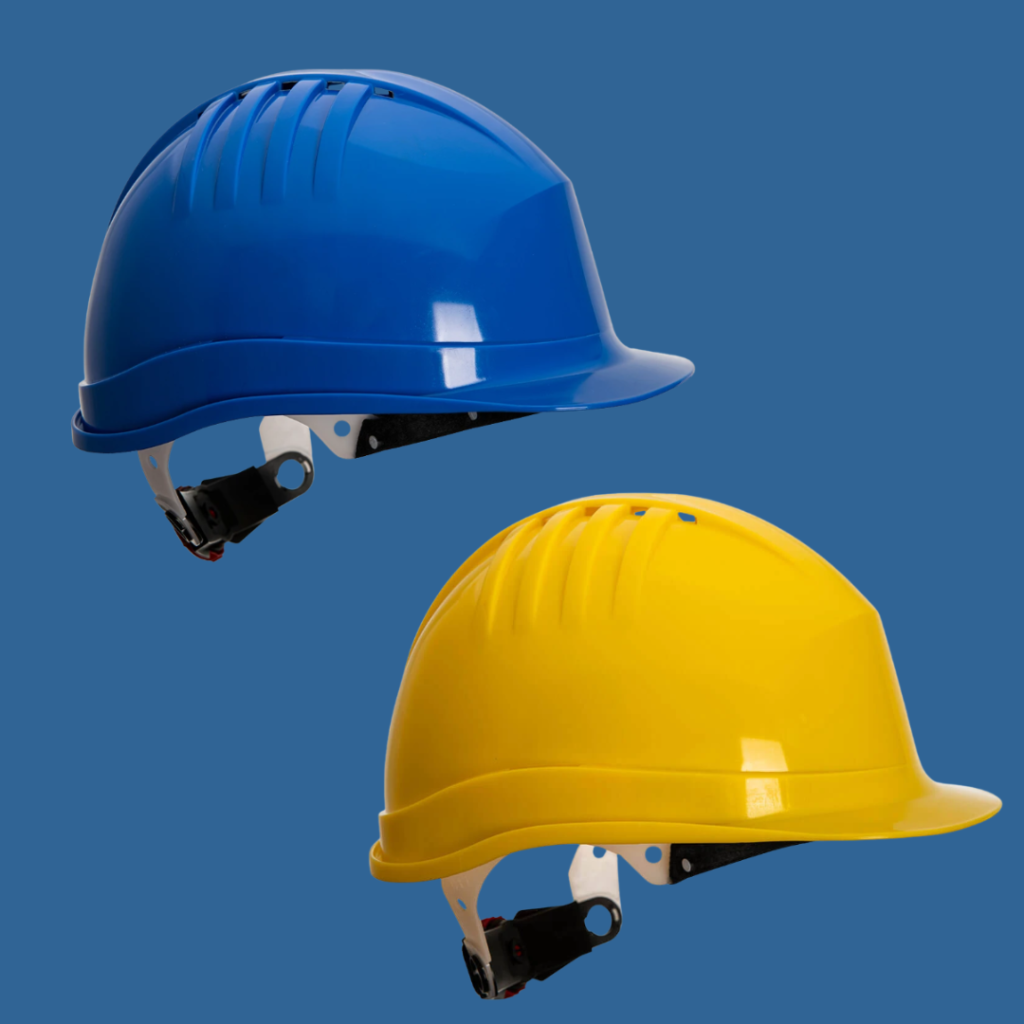
Find the Right Head Protection for Your Team
Explore MyWorkwear's range of hard hats and safety helmets and head protection accessories to find suitable options for your team.
FAQ's
Are hard hat colours standard in the UK?
While there is a recognised industry standard for using white, black, orange and blue helmets to identify roles these colours are not legally prescribed for every role at every UK workplace, and some sites have their own arrangements.
Does hard hat colour indicate the level of protection?
Put simply, no. Colour is generally used to identify a role, not a helmet's protective performance. Check the helmet's specification, applicable safety standards and suitability for the hazards involved.
Can I choose any colour hard hat?
We offer hard hats in a range of colours to suit different preferences, with some styles available in a wider choice of colours than others. Explore our range to find the options available for your preferred style. Before purchasing, we recommend checking with your employer or site manager, as your site’s PPE policy may specify which helmet colours are permitted or required.
When should you replace a hard hat?
We recommend that you replace a helmet immediately if it is damaged, has been involved in any sort of impact that may have compromised it, or is otherwise no longer safe to use. Follow the manufacturer's instructions on service life, inspection and replacement.
As a general guide, HSE guidance has cited replacement three years after manufacture for industrial safety helmets, but this is not a universal lifespan for every helmet. Material, storage, exposure, use and manufacturer recommendations can all affect service life.
Are all hard hats the same?
Safety helmets differ in design, materials, fit, impact performance and suitability for particular environments. Some are designed for general industrial use, while others are intended for specialist applications or particular hazards. Choose the appropriate helmet based on a risk assessment and the manufacturer's specifications.
Here at MyWorkwear, we have been proud suppliers of personalised workwear since 1976.
To see how we can provide the perfect workwear for your team to keep them looking professional and performing at their best, please click the button below.