

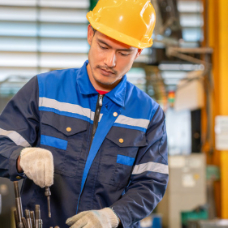
From production lines and engineering workshops to warehouses and quality control environments, manufacturing businesses operate in very different settings. Each places different demands on the people working there and the clothing they wear.
Choosing the right manufacturing workwear requires understanding role requirements, possible hazards, and how to achieve a consistent, professional appearance across a diverse workforce.
This guide covers garment types, safety standards, role-specific requirements, and ordering systems for businesses of every size.
What should you look for when choosing manufacturing uniforms?
Manufacturing environments vary considerably, so the right uniform for one business won’t work for another.
Durability and longevity
Garments face regular wear, repeated movement, and frequent laundering - often at high temperatures. Consider reinforced seams, strong fabric construction, and quality stitching. Factor in the full cost over the uniform’s lifespan, not just the unit price.
Comfort and practicality
Staff may be on their feet all shift, lifting, or operating machinery. Clothing that restricts movement or becomes uncomfortable by mid-afternoon affects both output and morale. Breathable fabrics and relevant garment weights - lighter for warm production areas, heavier for cold stores - make a practical difference.
Fit and sizing
Ensure garments are available in a full size range, including genuine female cuts. Women in manufacturing are frequently underserved by workwear designed around a male template, and scaled-down versions don’t always fit well. It’s also important to consider layering options for employees working in variable temperatures.
Easy maintenance
Choose colours and fabrics that suit the workplace and hold their shape through repeated washing. Dark garments hide wear in dirty conditions; lighter options show contamination quickly.
What types of clothing are suitable for manufacturing environments?
Garment | Suitable for |
Polo shirts | General factory staff, production teams, and warehouse employees |
T-shirts | Everyday workwear in warmer manufacturing environments |
Sweatshirts and hoodies | Employees working in cooler indoor environments |
Fleeces | Additional warmth for warehouse and production staff |
Softshell jackets | Employees moving across indoor and outdoor environments |
Work trousers | Production workers, engineers, and maintenance teams |
Coveralls and overalls | Environments where additional garment coverage is required |
Hi-vis clothing | Areas where greater visibility is required |
Safety footwear | Employees exposed to workplace foot hazards |
Polo shirts are the workhorse of manufacturing workwear. ProRTX polycotton options are hard-wearing enough for the factory floor without being uncomfortable to wear all shift. They also hold their shape through repeated washing and take embroidered branding well. A mid-weight polycotton (around 180-210gsm) is a reliable everyday choice for most production and factory staff.
Work trousers need reinforced knees, functional pockets, and enough stretch for a full active shift. Russell Athletic and Portwest options are built for the demands of a full workday. Regatta Professional fleeces suit employees who move inside and outside, while softshells combine wind resistance with stretch panels for unrestricted movement.
Coveralls and overalls provide full-body protection in environments involving oils, chemicals, or heavy soiling. Portwest covers a wide range of protection levels.
Hi-vis clothing is required wherever visibility is a safety consideration, from standard warehouse vests through to EN ISO 20471-certified garments for higher-risk applications. Safety footwear completes the picture - the right EN ISO 20345-rated specification depends on the hazards in your risk assessment.
Manufacturing workwear safety standards - what do you need to consider?
Selecting workwear for a manufacturing environment isn’t about appearance or comfort alone. Where hazards exist, clothing may need to deliver specific protective properties. Businesses have a legal duty to identify those hazards and equip staff accordingly.
The starting point is a workplace risk assessment. A food production facility has different requirements to a metal fabrication workshop, and standard workwear won’t provide adequate protection in every situation.
The standards below are example certifications for certain manufacturing environments, but are not a universal checklist.
Standard | What it covers |
EN ISO 20471 | High-visibility clothing - required where staff need to be seen clearly, like around moving vehicles |
EN ISO 11612 | Protective clothing against heat and flame - relevant for welding, foundry work, and other high-heat environments |
EN 1149-5 | Electrostatic properties of protective clothing - critical in places where static discharge presents a risk |
EN 13034 | Limited protection against liquid chemicals - relevant where exposure to chemical splashes is possible |
EN ISO 20345 | Safety footwear - specifies the requirements for footwear protection against particular workplace foot hazards |
Check garment labels carefully. A garment described as “flame resistant” may not specify formal certification, so look for the standard reference in the product data. Our team can help identify the right certified options for specific roles.
Choosing uniforms for different manufacturing roles
Production line workers, maintenance engineers, warehouse operatives, and office managers all have different workwear needs. A well-planned collection with consistent colours, logo placement, and customisation methods can cover the full workforce without sacrificing brand consistency.
Production line workers need breathable polos or t-shirts and durable work trousers. In warmer situations, lighter-weight fabrics (around 160-180gsm) help manage temperature. Snagging risks are a consideration too. Close-fitting cuffs and fewer external fastenings reduce the chance of loose clothing catching on machinery.
Engineers and maintenance teams need durable work trousers with reinforced knees and ample pockets, paired with polos, sweatshirts, and softshell jackets for varying conditions. Where processes involve heat, chemical exposure, or electrical hazards, select specialist flame-retardant workwear or other certified protective clothing through a formal risk assessment.
Warehouse and logistics staff benefit from layering - a polo or t-shirt base with a fleece or softshell for colder zones. Hi-vis is a requirement wherever pedestrians share space with vehicles. Select EN ISO 20471-rated garments based on the visibility class required for the area.
Welding and fabrication teams have the most specific requirements. Heat, sparks, UV radiation, and molten metal spatter mean standard workwear is rarely adequate. Choose specialist clothing certified to EN ISO 11612, along with appropriate gloves and footwear, based on a detailed assessment of the processes involved.
Office and management teams still benefit from branded workwear for factory floor visits and customer meetings. Polos, shirts, and softshells work well. Using the same branding elements across all garment types keeps the overall appearance cohesive.
Why choose custom branded manufacturing uniforms?
Branded uniforms do more than create a consistent look. They shape how customers, suppliers, and potential employees perceive the business. They also help build a recognisable identity across the workforce, whether employees are on the factory floor, visiting customers, or attending industry events.
A workforce in consistent, well-presented branded clothing signals professionalism. For shop floor staff and office teams that can feel quite separate in a larger manufacturing business, shared workwear creates a sense of belonging to the same organisation. Using the same colours, logos, and garment styles also helps maintain that consistency as the workforce grows.
The two main methods of customisation are embroidery and printing. Embroidery is the standard for professional workwear - polos, fleeces, softshells, and jackets - producing a durable finish that holds up through repeated industrial washing.
Print handles complex colours and large back designs better, but it's less durable under heavy laundering. For most manufacturing garments, embroidery is the more practical long-term choice.
How to manage workwear for a large manufacturing workforce
For larger manufacturing businesses, managing workwear manually quickly becomes a burden. Provisioning new starters, approving orders, and maintaining consistency across departments all add up.
MyWorkwear’s workwear ordering portal replaces this with a structured system. Employees log in, see only the garments approved for their role, and order within set parameters. We can configure approval workflows, spend limits, and PO number requirements to match internal processes, and we support multi-site delivery with individually bagged and named garments.
For businesses with 25 or more employees, we offer dedicated account management. We can provide ongoing support with garment selection, new product introductions, and responsive service as requirements change.
Manufacturing uniform examples - how other businesses approach their workwear
We work with several manufacturing and engineering businesses across sectors and scales. Here’s how four of them approach their workwear.
Boneham & Turner - precision engineering
A partnership dating back to 2017. The collection covers shirts, polos, fleeces, and softshell jackets - from customer-facing sales staff to workshop employees - all in black with contrasting white embroidered branding, applied consistently across every garment type.
Darchem Engineering - varied engineering environments
A multi-site operation with staff ranging from office teams to shop-floor engineers. We supply polos, shirts, softshell jackets, and specialist protective clothing, with flame-resistant garments incorporated for roles that require them.
iconsys - growing engineering and manufacturing workforce
A Telford-based business with software, electrical, and manufacturing engineering teams. The collection covers polos, shirts, trousers, jackets, and specialist workwear. As iconsys has grown, our ordering portal has taken the burden of repeat orders and new starter provisioning off the HR team.
In-Comm - industrial training environments
An industrial training provider across two sites, with staff uniforms and PPE for students and learners. We have supported In-Comm for over 12 years - durability, consistency, and responsive service are non-negotiable in a training environment where garments are in daily use.